23.09.2026
We're backing Azulene Labs' groundbreaking approach to chemistry
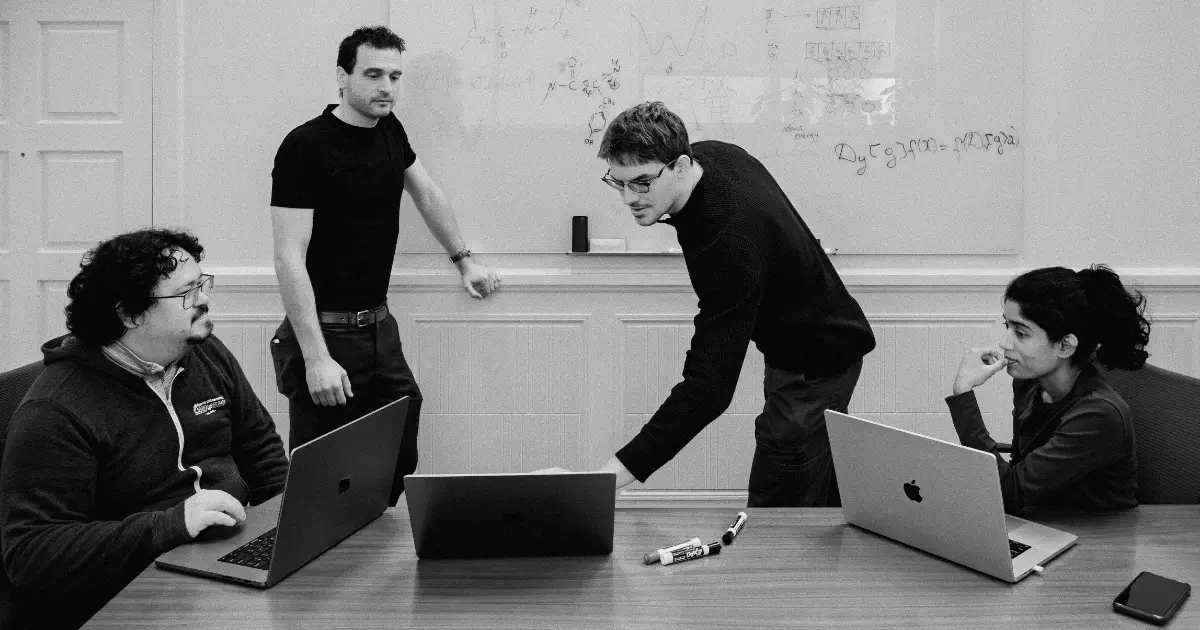
Welcome to the latest addition to our portfolio: we’ve led a $3.4 million pre-seed round into Azulene Labs, a startup creating the future of drug and materials development.
While mechanical and civil engineers design new products with high-precision software, chemistry has traditionally been far less precise. For example, even after 60 years of computer modeling, predictions of how tightly a drug sticks to its target protein are still routinely wrong by a factor of 100 or more.
Azulene Labs is rebuilding the simulation stack to make chemistry and biochemistry modeling truly predictive for the first time. It is building high-accuracy, physics-based foundation models that provide around 100 times the efficiency of competitors while being at least 200 times more cost-effective.
“An airplane is specified down to manufacturing tolerances before anyone builds a prototype. A skyscraper is load-tested in simulation before a single beam goes up. These ‘macroscopic’ models are so accurate that you can put enormous trust in them. Chemistry has had nothing like this. Until now,” says Azulene Labs co-founder Nicolas Sawaya.
“Chemistry should work the way aerospace engineering already works, where you design the thing in a computer, you believe the answer, and the physical object behaves as predicted the first time you build it.”
To achieve this, Azulene Labs uses quantum-mechanical training data that produces far more high-quality data and higher-accuracy AI models for the same amount of capital as other approaches.
While there have been significant advances in AI-based chemistry modeling in recent years, existing models routinely produce structures that are deeply inaccurate, or worse, physically impossible. Azulene Labs’ models are constrained to the laws of physics in ways that the current cutting-edge AI models are not.
The technology can make a significant impact on product development across pharma, agriculture, energy storage, plastics, and industrial chemicals.
“Imagine cancer medicines aimed at proteins the industry wrote off as undruggable decades ago; new antibiotics for infections that have stopped responding to everything we have; replacements for the solvents the chemical industry runs on by the megaton, many of which are toxic enough that regulators are phasing them out with no good substitute yet found, or plastics that perform like the ones we use today but break down completely afterward instead of persisting for centuries,” Nicolas says.
Nicolas, who holds a PhD in chemical physics from Harvard, founded Azulene Labs after leading quantum algorithm development for chemistry at Intel Labs. The founding team includes scientists with PhDs from Caltech, Harvard, UC Berkeley, Columbia, and MIPT.
The new funds will be spent on expanding the team and further product development. The company is currently working with end-users in the biotech and industrial chemistry markets.